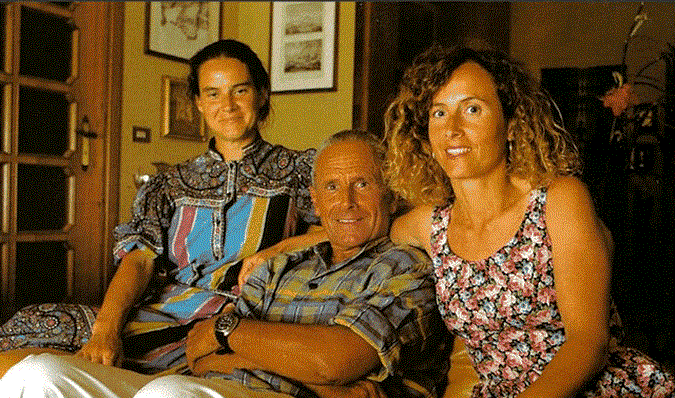
Rossana Maiorca has been trending in search results as readers revisit the golden era of freediving. Born in 1964, this Italian athlete shattered expectations when she reached a depth of 101 meters in constant weight apnea in 1996. Her story intertwines record-breaking dives with a lifelong commitment to marine conservation.
How a Sicilian Family Shaped a Freediving Champion
Rossana Maiorca grew up in Sicily surrounded by the sea. Her father, Enzo Maiorca, was a legendary freediver who held multiple world records in the 1960s and 1970s. From an early age, Rossana trained in the waters off the Sicilian coast. She learned breath-hold techniques and developed the mental discipline required for deep diving. By the early 1990s, she began competing in international freediving events. Her family background gave her a unique foundation, but she built her own path through rigorous training and a deep understanding of ocean dynamics. com/us/who-was-rossana-maiorca-and-how-did-she-die/” rel=”noopener noreferrer” target=”_blank”>Who Was Rossana Maiorca and How Did She Die? – BuzzNigeria. Background on rossana maiorca is documented in Who Was Rossana Maiorca and How Did She Die? – BuzzNigeria.com
Clearing Up Misconceptions About Rossana Maiorca’s Records
Some sources claim Rossana Maiorca broke her father’s world record in 1996. That is accurate, but the details matter. Enzo Maiorca’s record was set in variable weight apnea, while Rossana’s 101-meter dive was in constant weight apnea—a discipline where the diver uses only fins and cannot pull on the rope. This distinction is important because constant weight is considered more physically demanding. Another misconception is that she retired immediately after that dive. In reality, she continued competing for several more years, setting additional Italian records before retiring in the early 2000s. Her career spanned over a decade of elite competition.
Key Milestones in Rossana Maiorca’s Career and Activism
Rossana Maiorca’s timeline includes several notable achievements. In 1994, she set her first Italian national record. Her breakthrough came in 1996 when she reached 101 meters, surpassing her father’s mark and placing her among the world’s top freedivers. She later authored books on freediving techniques and marine conservation. After retiring from competition, she co-founded the Marevivo environmental organization in Sicily. In 2021, she participated in protests against oil drilling off the Sicilian coast, advocating for marine protected areas. Her transition from athlete to activist reflects a consistent dedication to the ocean.
| Year | Milestone |
|---|---|
| 1994 | First Italian national record in freediving |
| 1996 | World record dive to 101 meters in constant weight apnea |
| Early 2000s | Retired from competitive freediving |
| 2000s–2010s | Co-founded Marevivo; authored books on freediving and conservation |
| 2021 | Protested against oil drilling off Sicily |
Why Rossana Maiorca Still Inspires Divers and Environmentalists
Rossana Maiorca’s impact extends beyond her records. She demonstrated that women could compete at the highest levels of freediving, a sport historically dominated by men. Her work with Marevivo has raised awareness about marine pollution and the need for protected areas. In Italy, she is often cited as a role model for combining athletic excellence with environmental stewardship. Freediving communities worldwide still reference her 1996 dive as a benchmark. Her books continue to be read by aspiring freedivers who seek both technical knowledge and a conservation ethic.
Frequently Asked Questions
Did Rossana Maiorca really break her father’s world record, or is that a rumor?
However, the record was in a different discipline—constant weight apnea versus variable weight—so the comparison is not direct.
When did Rossana Maiorca set her 101-meter world record?
She set the record in 1996. The exact date is not widely publicized, but the dive took place during a competition off the coast of Sicily. It marked a peak in her competitive career.
What is Rossana Maiorca best known for today?
She is best known for her freediving world record and her subsequent environmental activism. Many also recognize her as the daughter of Enzo Maiorca, but she has built her own legacy through marine conservation work with Marevivo.
Where was Rossana Maiorca born and where does she live now?
She was born in Sicily, Italy, in 1964. She continues to live in Sicily, where she is active in local environmental campaigns and occasionally gives talks on freediving and ocean protection.
Why did Rossana Maiorca stop competitive freediving?
She retired in the early 2000s, citing a desire to focus on marine biology and environmental advocacy. The physical and mental demands of elite freediving also played a role in her decision to step away from competition.
The Technical Side of Rossana Maiorca’s Training Regimen
Rossana Maiorca’s training combined physical conditioning with mental preparation. She practiced static apnea—holding her breath while floating face-down in a pool—to increase lung capacity. Dynamic apnea exercises, where she swam horizontally underwater, built endurance. Her father’s coaching emphasized relaxation techniques to lower heart rate and oxygen consumption. She also studied marine currents and water temperature to optimize dive timing. This holistic approach allowed her to push physiological limits safely.
How Rossana Maiorca’s Legacy Lives On in Modern Freediving
Today’s freedivers often cite Rossana Maiorca as a pioneer for women in the sport. Her 101-meter dive remains a reference point for constant weight apnea records. The Marevivo organization she co-founded continues to run beach cleanups and educational programs in Italian schools. In 2023, a documentary about the Maiorca family aired on Italian television, renewing public interest in her story. Her books on freediving technique are still used in training courses across Europe.